Nestled amongst pine clad hills, Spa is one of the oldest and most legendary of the Formula 1 circuits. They started racing here 100 years ago as a novel alternative to the then popular city to city races. The current circuit is often mentioned by Formula 1 drivers as their favourite and the plunge downhill to Eau Rouge before the climb up to Les Combes is regarded as one of the most perfect racing corners in the world. I have never driven the current circuit but doing so is certainly on my bucket list.

I was last at Spa for the Belgian GP in 1998. The weather was unusually fine but the race was dull. Schumacher and Ferrari were in their pomp and pretty soon the race began to resemble the sort of dull processions that did so much to turn off fans in the Schumacher era. Even sitting at the bottom of Eau Rouge could not make things more interesting and that race was the last F1 race I went to for 12 years.

The Spa circuit we see today is only a fraction of the Spa circuit that was in use from 1902 until 1978. That circuit was much much longer at 15km in length and had a reputation for appalling weather and danger as notorious as that of its near neighbour across the German border, the Nurburgring.

The typically wet weather, the lack of run off and the brooding trees claimed many lives, even before the War. Dick Seaman was killed here in his works Mercedes on 1939. Throughout the fifties and sixties lap times shortened as cars got quicker. Inevitably the danger increased. For example the 1960 GP claimed two British drivers, Chris Bristow and Alan Stacey. Stirling Moss was also injured.

The weather for the 1966 race was awful and Jackie Stewart had a serious accident he was lucky to survive. Having crashed on a remote part of the track he had to rely on fellow competitor Graham Hill to pull him from his car. Jackie has often said that it was this accident that started his campaign for better safety in Formula 1.

Those running Spa made little effort to make the circuit safer and F1 ceased to race on the old circuit in 1970. Sports car racing continued, lap times got quicker still and the death toll mounted. Three drivers died in the 1973 Spa 1000km race. The lap record (that still stands) was set in that era by Pedro Rodriguez in a Porsche 917 at an incredible average speed of over 150 mph.

Finally, in 1978 the old circuit was closed and reconfigured. It was reopened in the shorter form we see today and GP racing returned in 1983. The public roads that bore the old circuit reverted to full time public highways and can be driven today.

You join the old circuit at Les Combes and meander slowly down hill through the village of Burneville. It’s pretty straight and an F1 car would be going very fast as you enter the long right hander at the bottom of the hill. Houses and junctions keep your speed down and it is hard to believe you are on such a notorious circuit.

The long straight between Malmedy and Stavelot is interrupted by the infamous Masta Kink. It’s been tightened in modern times but its old configuration can be seen in the lay – by that sits where the wicked left / right must have terrified drivers in the past. Motorsport’s famous correspondent Dennis Jenkinson used to sit above the Kink and watch and listen to the passing racers to see who could take the Kink flat out and who would lift off. To him it was the ultimate test of a driver.

Just before Stavelot a cambered right hander takes the old circuit back towards Blanchimont and the new circuit. The crumbling Tarmac and flaking Armco at the beginning of this stretch are from the original circuit. Finally, with little traffic and few houses, it is possible to open up the throttle a bit. The road is very straight and its easy to see why the old circuit was so fast. Pretty soon you arrive at some huge gates that mark the point the old circuit joins the new, but for at least a few seconds its possible to imagine how Fangio, Moss, Stewart and Rodriguez must have felt all those years ago.

Below: Masta Kink isn’t what it used to be; Blanchimont gates; Rodriguez’s Porsche 917

20130310-084807.jpg

20130310-084826.jpg

20130310-084840.jpg

This year’s Abu Dhabi Grand Prix was perhaps the most exciting race of the season thanks to some fantastic, and not so fantastic, driving. From the first corner pile up to Hamilton’s McLaren breaking (again) when he seemed to have the race tied up, it was edge of the seat stuff.

The race produced a tremendous result for Lotus, Raikkonen, Vettel, Alonso and Abu Dhabi itself.

Last year I attended the Abu Dhabi GP as a guest of Lotus and I know how much winning a GP means to them. An excellent bunch, owned by real enthusiasts, they deserve their success.

Despite being third in the championship Raikkonen had not won a race until Abu Dhabi. And though he did not seem overly pleased with the result, the fact he finally proved all those who doubted the wisdom of his return to F1 wrong, must be pleasing.

Vettel’s drive to third from the back of the grid was remarkable. Although he clearly benefited from the three safety car periods he pulled off a number of fine overtaking moves. He is looking strong for the championship.

Alonso also drove well and his second place just about keeps his title ambitions alive.

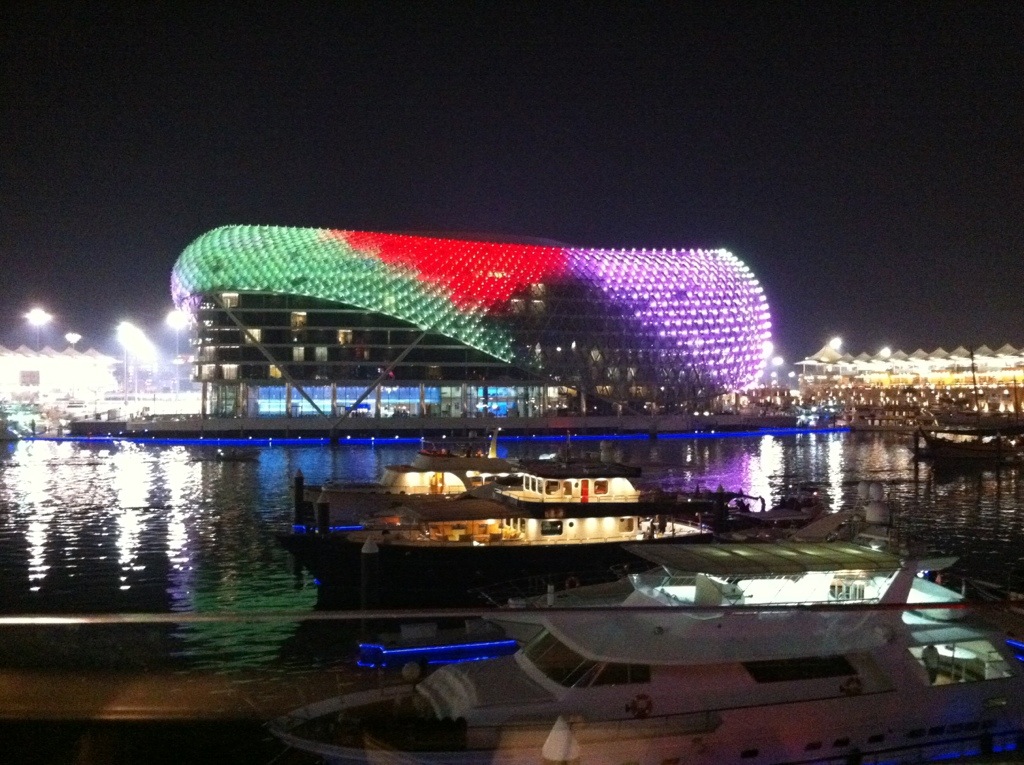
Finally, it was great to see Abu Dhabi hosting such an exciting race. The facilities for spectators are excellent, the locals friendly and the city fascinating. The new Pirelli tyres, coupled with DRS and KERS, have turned what was another boring modern circuit into one of the most exciting away venues for British F1 fans.

20121104-224949.jpg

20121104-225142.jpg

Another Grand Prix and another dominant Red Bull performance. The recent tweaks to their cars have relegated the opposition to mere spectators. And if it wasn’t for late mechanical problems with Webber’s car, Red Bull would have converted a qualifying one two into the same result on the podium. As it was, another fine drive by Alonso took him from fifth on the grid to second to keep his title hopes alive.

20121029-092943.jpg

Image

MP4 at the RAC – Spring 2012

Recently I had the pleasure of a tour of McLaren’s slightly sinister technology centre at Woking and the opportunity to test drive the latest version of the MP4 at Goodwood and on the roads of the South Downs.

When it was first announced I was excited about a British super car to rival Ferrari. And, at approximately £120,000, I could (with some financial engineering that would make my prudent father choke on his Lidl cornflakes) even dream of owning one.

First impressions were favourable – the MP4 is a fine looking car, particularly in McLaren orange. The stunning curves and compact lines ooze quality and McLaren’s famous attention to detail.  Even before I drove the car I put my name down as a potential customer. But then the Ferrari 458 was launched and McLaren decided to increase the price of the MP4 to match that of the Ferrari – some £170,000 plus. That put the car beyond me and made me wonder if McLaren’s attempt to compete with the Ferrari was wise.

The famously fast Goodwood circuit was the perfect place to test the car’s performance. Despite the insertion of two additional chicanes, the sheer speed of the MP4 was still enough to scare me. Acceleration was brutal, cornering sharp and the brakes superb. Handling was sublime. Not once did the car feel unbalanced even when my journeyman attempts at hard cornering caused the instructor accompanying me to wince. So on the track or at full chat the MP4 is a genuine super car.

But for a car to be a good super car it needs to be more than just dynamically good. As I drove an MP4 around the country lanes near Goodwood the McLaren marketing guy sat at my side assured me that the MP4 was a car you could live with every day. He selected (through a couple of neat and simple knobs on the dash) “normal” suspension and throttle settings and set the car’s gear box to full automatic.  It pootled around quite well but we both knew that no one would pay £170,000 for a car then take it to Tesco. And even if you did you would not be able to get out due to those smart gull wing doors banging the cars next to you. When I was driving the MP4 it wasn’t neighbouring cars that were being clobbered by the doors but my head every time I bent myself into the driver’s seat. I’m only in my forties but after getting in and out of the MP4 all day, I felt several decades older.  Whilst I expect that the MP4 does in comfort mode (or whatever it is called) have a more compliant ride than other super cars, compared to a GT it still feels harsh. This is not a car you would want to drive to the South of France.

But with a super car you don’t really want to drive to the shops, or to the South of France, or do anything sensible. You want to hare around, impress your friends and demonstrate your taste and wealth. Does the MP4 do the trick? Its a fine looking car but (and its been said before) it lacks the drama and charisma of the Ferrari 458. In addition, and crucially, when not on the track it sounds anaemic, like a Kia with a broken exhaust pipe. How could McLaren not have noticed this? McLaren already have to overcome the handicap of a brand lacking the virile rosso glamour of the prancing horse. Pricing the MP4 at the same level as the 458 was brave but undoubtedly leads customers to compare the two cars. By all accounts, the MP4 has the edge over the 458 dynamically. But I suspect to many potential customers that won’t be of overriding importance. For them the 458 will  win the battle on looks, sound and the glamour of that famous badge.

Image

Bet Greenpeace love the plate..