Across town from the Porsche Museum in Stuttgart is another striking modern building dedicated to motoring history. The Mercedes-Benz Museum is, like its owner, on a different scale to its Porsche rival. Entering through the ground floor you are required to take a lift to the top of the hollow concrete drum that houses the Museum and work your way down to the bottom on a long spiral ramp. A sort of motoring version of the Guggenheim Museum in New York!
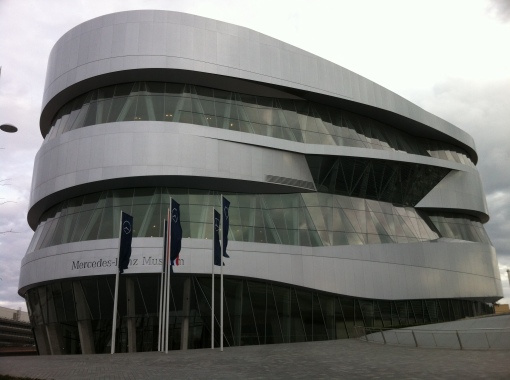
Mercedes Benz Museum, Stuttgart
The Museum starts by looking closely at the work of the company’s founder and the inventor of the high-speed petrol engine, Gottleib Daimler. Daimler was a pioneer of the internal combustion engine and with his business partner, Wilhelm Maybach, founded Daimler in 1890. The company merged with Karl Benz’s eponymous company in 1926 to form Daimler Benz.
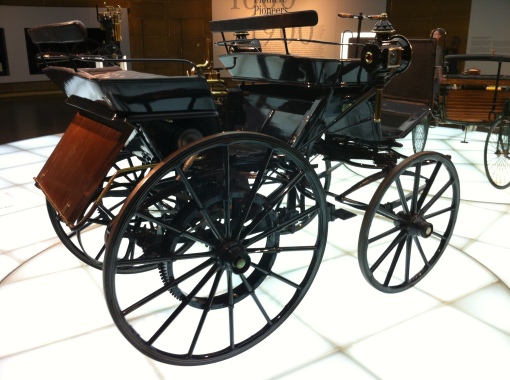
Daimler Motorised Carriage, 1886. This is the world’s first four wheeled motor vehicle and was powered by the “grandfather clock” engine.
The Museum holds an example of the first petrol engine that Daimler and Maybach produced in 1885, a 264cc single cylinder air-cooled engine, nicknamed (because of its appearance) “the grandfather clock engine”. Initially Daimler were more concerned with licensing the designs of their innovative engines than in building their own cars. In France Peugeot began installing Daimler designed engines in their early motor cars and in 1894 British industrialist Frederick Simms bought the UK licence to the latest Daimler engine and the right to use the name Daimler. This led to the establishment of the British company, Daimler Motors, now a dormant brand owned by Jaguar Land Rover, but until recently responsible for producing luxurious cars much favoured by the British Royal Family.
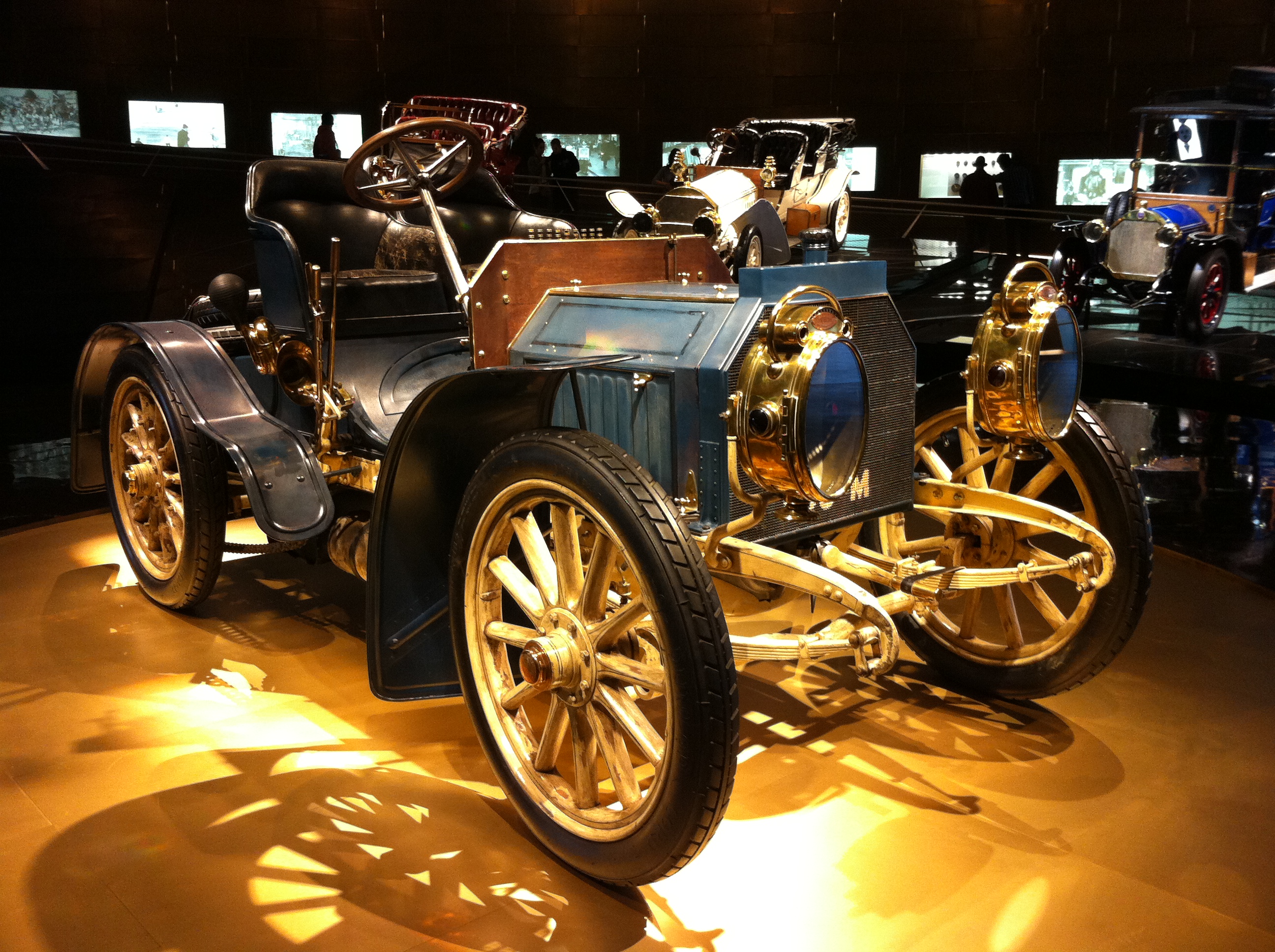
Mercedes-Benz is now a division of the industrial behemoth that is Daimler AG. The Mercedes part of the name stems from the name of the daughter of Austrian motor dealer, diplomat and racing driver, Emil Jellinek. He had ordered and modified a racing Daimler in 1901 which he used to win many of the early French motor races. He called the car Mercedes after his daughter and the name soon became associated with success. So much so that Daimler changed the name of their cars to “Daimler Mercedes”. On the merger with Benz it was the Daimler part of the name that was dropped. Mercedes-Benz motor cars have long been favoured by the wealthy and powerful. Hitler was very fond of them, obviously not seeing the irony of driving a car named in part after a young Jewish girl.
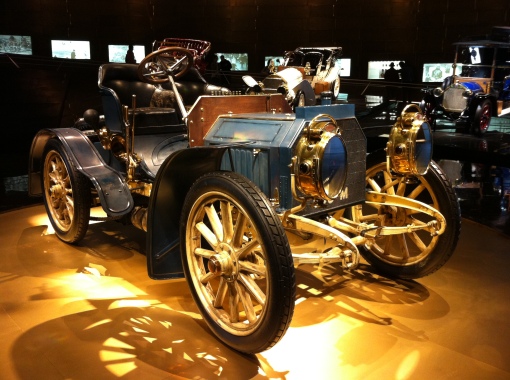
Mercedes Simplex 1902. This is the oldest Mercedes in the existence and bears the name of Emil
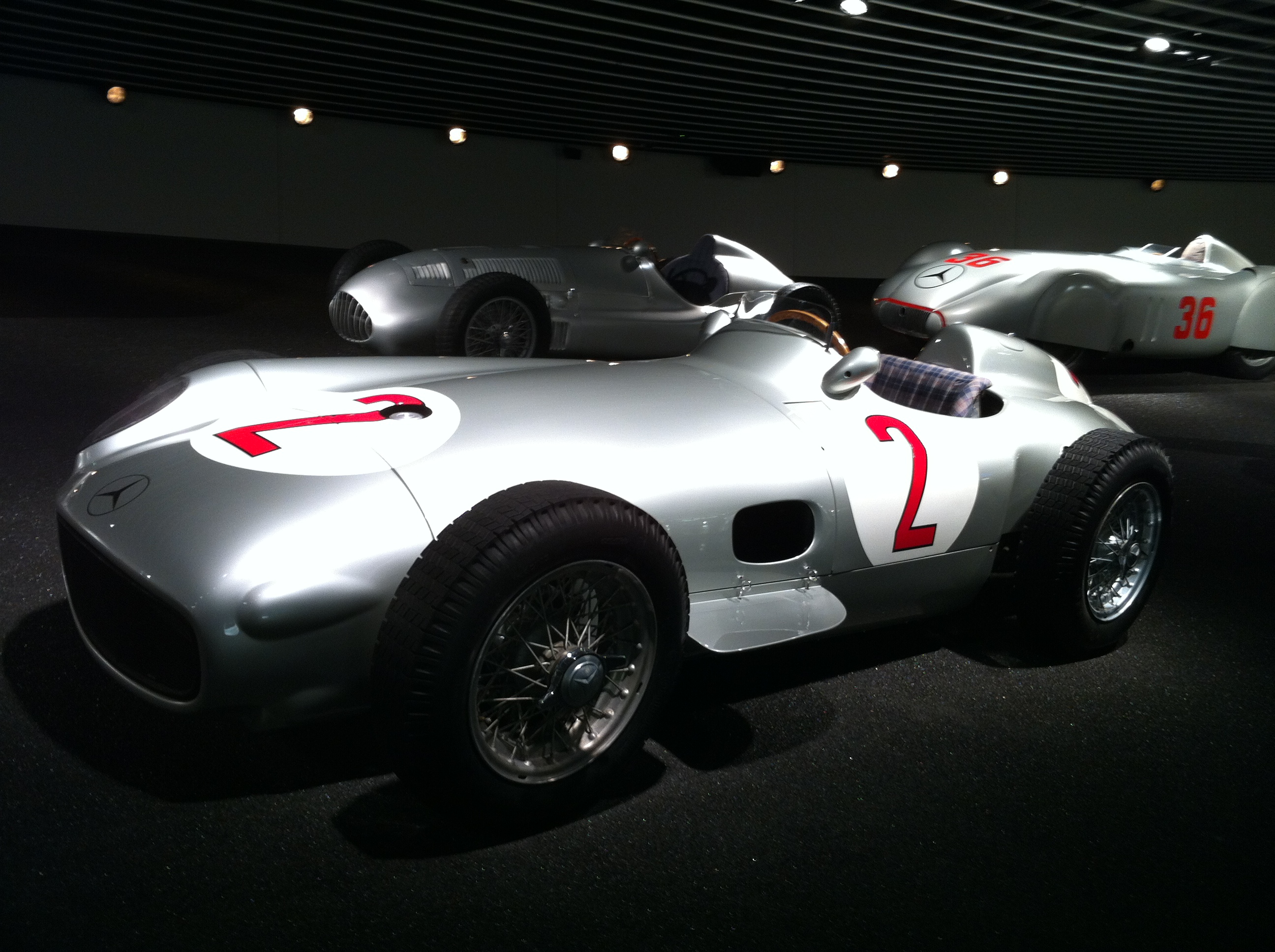
Jellinek’s daughter, Mercedes.The Museum covers all aspects of Mercedes-Benz, from buses and trucks to aero engines. There is a fine selection of solid but frankly dull road cars too. But what I was at the Museum to see was the fine examples of the company’s motor sport heritage. Mercedes-Benz have been involved in motorsport on and off since the earliest days of the company. A Benz competed in the world’s first motor race, the 1894 Paris to Rouen road race. The 1930’s brought the glory years of the Silver Arrows when great drivers such as Caracciola, backed by the industrial might of the Third Reich and Adolf Hitler himself, dominated Grand Prix racing. After the war Mercedes-Benz again returned to racing and again dominated Grand prix racing in a technical tour de force that saw Fangio win the world title twice in 1954 and 1955.
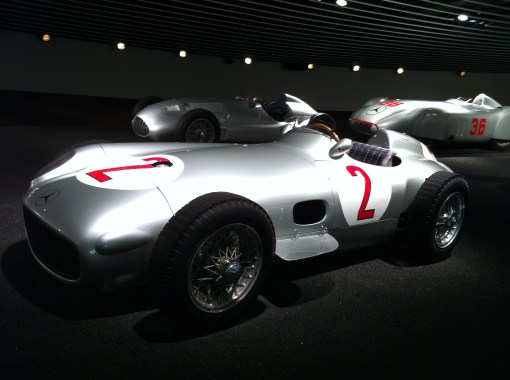
Fangio’s MB W196 in which he won his third world title in 1955. Behind is Caracciola’s 1938 MB W154 in which he won his third European title.
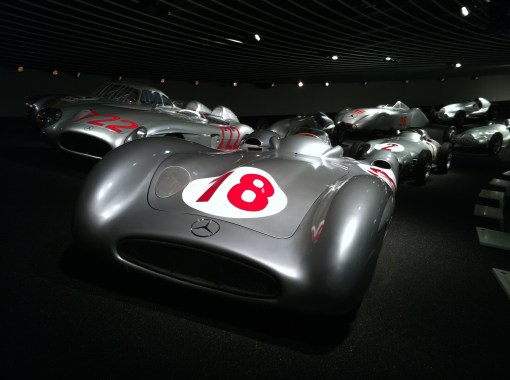
Fangio’s MB W196 Streamliner, used at high speed tracks such as Reims and Monza.
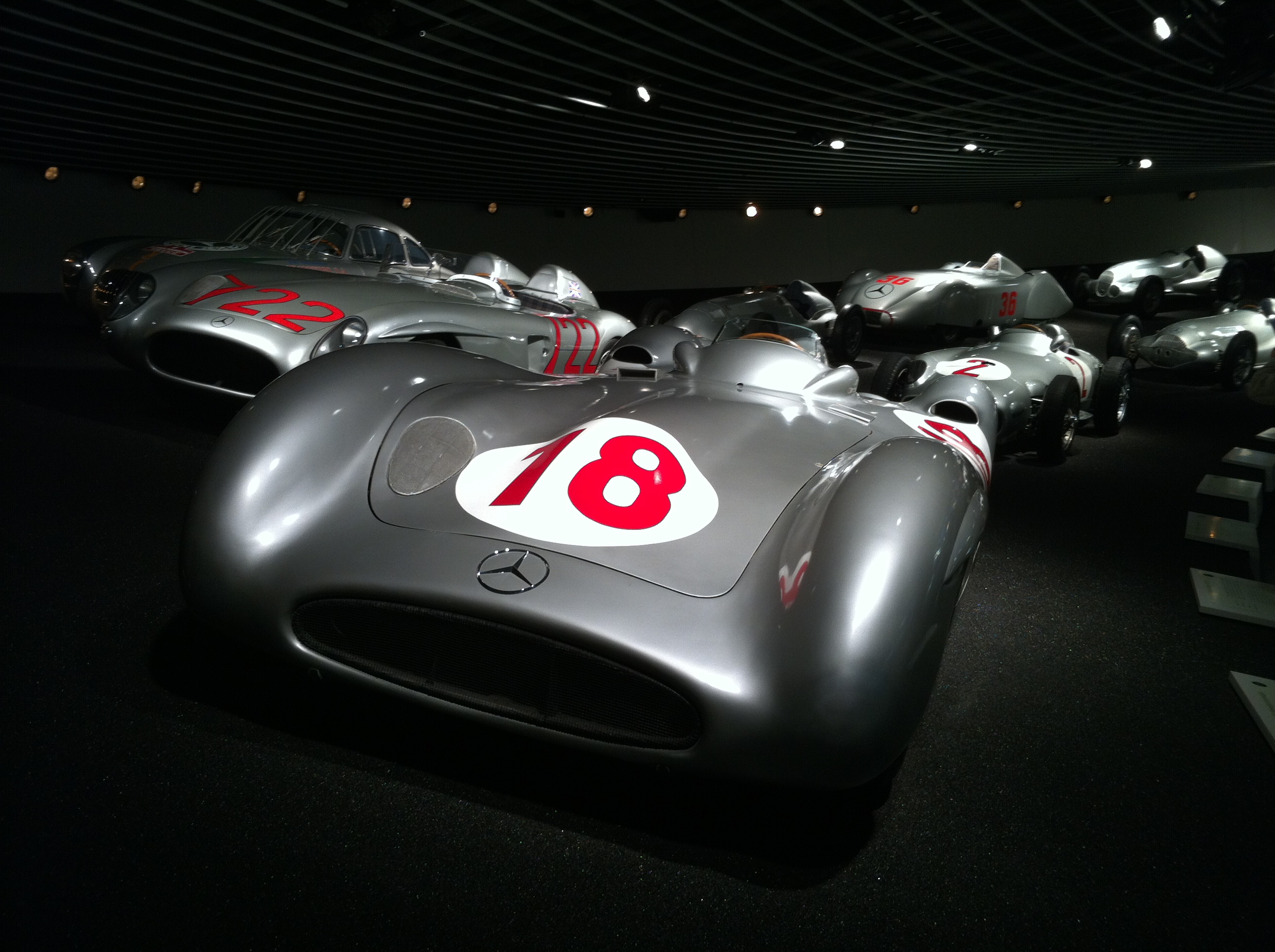
Stirling Moss was also a Mercedes-Benz works driver at the time and, with Motorsport’s legendary journalist Dennis Jenkinson, he won the Mille Miglia in 1955 in the fabulous MB 300 SLR. Sadly the Le Mans disaster of the same year, when Leveagh’s 300SLR collided with Macklin’s Austin Healey 100 and somersaulted into the stands killing over 80 spectators, led Mercedes-Benz to withdraw from motor sport.
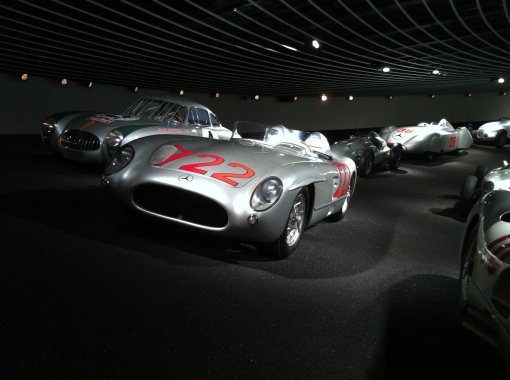
The Moss / Jenkinson 1955 Mille Miglia winning MB 300SLR. This car is probably worth in excess of £50m.
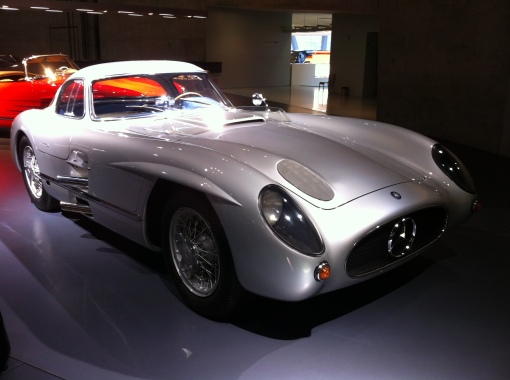
The 1955 MB 300SLR “Uhlenhaut Coupe”. A hard top version of the Moss / Jenkinson car intended for use in 1956. It never raced after MB’s withdrawal from racing in 1955 and instead became the company car of MB chief engineer Rudi Uhlenhaut!
For many years thereafter Mercedes-Benz concentrated on road cars but they did support those who wanted to go rallying. The Museum holds a particularly interesting car for me, the MB 280E that carried a British crew to victory in the London – Sydney Rally in 1977. My uncle Adi competed in the same rally in a Lotus Cortina Mk2. I can remember as an eight year old standing in the cold early morning watching this very Mercedes Benz being flagged away from the start in the centre of London.
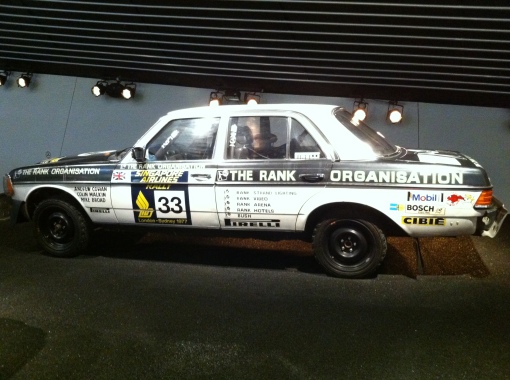
MB 280E, winner of the London – Sydney Rally 1977
Mercedes Benz returned to mainstream racing in 1987 with an assault on Le Mans and German Touring Car racing. Examples of their diverse racing machines are displayed in the Museum alongside the car from their 1930’s and 1950’s glory days.
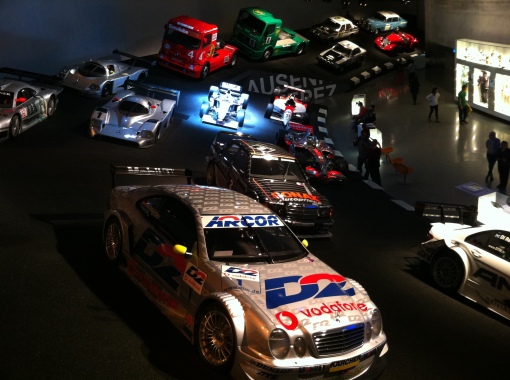
MB Touring Car (DTM)
In F1, Mercedes Benz also supplied engines to Sauber and until recently part owned McLaren. They now own the old Brawn racing team who are looking strong this year already. Given Mercedes Benz’s past record in motor sport and their recent recruitment of Lauda and Hamilton (two men determined to be winners) I have no doubt that the world title will, before long, again return to the Silver Arrows.
The Mercedes Benz Museum is exceptional and well worth the visit to Stuttgart alone. One comes away in awe of the company’s technical achievements and with a firm belief that they have always thrived, and will no doubt continue to do so, by adhering to Gottlieb Daimler’s famous dictum “Das beste oder nichts” (“The best or nothing”).






 morewheelspin